Good record keeping is one of those things that nobody finds exciting, but it can save you thousands of dollars and a lot of stress when tax time rolls around. For content creators, the challenge is that income comes from multiple streams, expenses are often a mix of personal and business, and things like gifted products and contra deals make tracking even more complicated.
Here is a practical guide to getting your records in order so you are always prepared, whether it is for your annual tax return or an unexpected ATO review.
The ATO's Five-Year Retention Rule
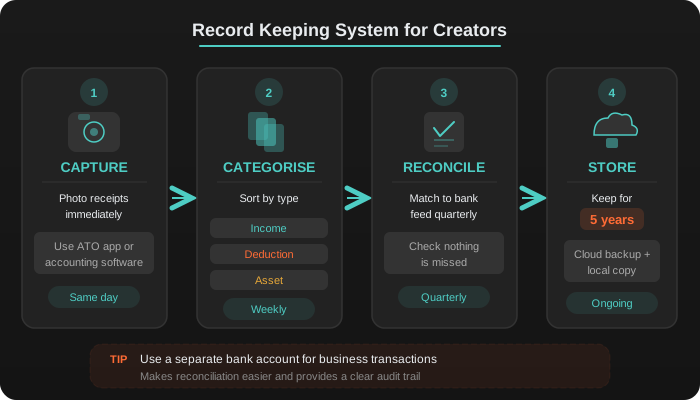
The ATO requires you to keep all business records for at least five years from the date you lodge your tax return for that financial year. This applies to everything: income records, expense receipts, bank statements, contracts, invoices, and any other documentation related to your creator business.
If you claim depreciation on an asset like a camera or computer, you need to keep records for five years from the date of your last claim for that asset. So if you are depreciating a $3,000 camera over four years, you need to keep the receipt for at least nine years from the purchase date.
Failing to keep adequate records is not just a compliance issue. If the ATO audits you and you cannot substantiate your deductions, those deductions get disallowed and you could face penalties on top of the additional tax owed.
Tracking Multiple Income Streams
Most creators earn money from more than one source. You might have YouTube AdSense revenue, brand deal payments, Patreon subscribers, affiliate commissions, and income from selling your own products or courses. Each of these needs to be tracked separately.
The simplest approach is to use accounting software like Xero or MYOB and set up a separate income category for each stream. This makes it easy to see exactly where your money is coming from and ensures nothing gets missed when your accountant prepares your return. At a minimum, keep a spreadsheet that logs every payment received, the date, the source, and the amount.
Do not rely on platform dashboards alone. Payment platforms can change their reporting, go offline, or delete historical data. Always download your payment summaries at the end of each financial year and save them.
Receipt Management: Use an App
Paper receipts fade. They get lost. They end up in a crumpled pile at the bottom of a drawer. The good news is that the ATO fully accepts digital copies, so there is no reason to keep paper originals if you have a clear digital version.
Apps like Dext (formerly Receipt Bank) and Hubdoc let you snap a photo of a receipt on your phone and automatically extract the key details like date, amount, supplier, and GST. These apps can connect directly to your accounting software so receipts are matched to transactions without manual data entry.
If you do not want to pay for a dedicated app, the ATO's free myDeductions app is a solid option for recording expenses on the go. The key habit to build is capturing receipts immediately. Do not wait until the end of the quarter or year, because that is when things get lost.
Separating Business and Personal Expenses
This is one of the most important things you can do as a creator, and one of the most common areas where people get it wrong. Open a dedicated business bank account and use it exclusively for business income and expenses. Most banks offer free or low-cost business transaction accounts.
When all your business transactions flow through one account, it becomes dramatically easier to reconcile your books, identify deductible expenses, and provide clean records to your accountant. Mixing personal and business transactions in the same account creates confusion, increases the risk of errors, and makes ATO reviews far more painful than they need to be.
If you use a credit card for business purchases, consider having a separate business credit card as well. This keeps your personal spending completely separate from your deductible expenses.
Bank Feeds and Quarterly Reconciliation
If you are using accounting software, connect your business bank account via a bank feed. This automatically imports your transactions into the software daily, so you do not have to manually enter anything. All you need to do is categorise each transaction as it comes in.
Make a habit of reconciling your accounts at least quarterly. This means matching your bank feed transactions to your invoices, receipts, and records. Quarterly reconciliation ensures that nothing falls through the cracks and that your books are always close to up-to-date. If you leave it all until June, you are looking at twelve months of transactions to sort through, and that is when mistakes happen.
If you are registered for GST, quarterly reconciliation aligns perfectly with your BAS lodgement schedule, so you are essentially killing two birds with one stone.
What Records to Keep for Equipment Depreciation
Content creators often invest heavily in equipment: cameras, lenses, lighting rigs, microphones, computers, editing monitors, drones, and more. For each asset, you need to keep:
- The purchase receipt or tax invoice showing the date, amount, and supplier
- A record of the business-use percentage. If you use a camera 80% for content creation and 20% for personal use, you can only claim 80% of the depreciation.
- The depreciation method and effective life. Items over $300 generally need to be depreciated over their effective life. The ATO publishes a guide to effective life for most asset types.
- Any maintenance or repair receipts for the asset
- Disposal records if you sell or discard the asset, including the sale price and date
For items costing $300 or less, you can claim an immediate deduction in the year of purchase, but you still need to keep the receipt for five years.
Digital vs Paper Records
The ATO accepts both digital and paper records, but digital is strongly recommended for content creators. Digital records are easier to search, organise, back up, and share with your accountant. They also do not fade or get damaged.
If you do keep paper records, make sure you also create digital backups. A quick phone photo of a receipt stored in a dedicated folder or app is enough. Store your digital records in at least two locations, such as cloud storage and a local backup, to protect against data loss.
Whatever system you use, the key is consistency. Pick a method, stick with it, and make it part of your routine. The creators who stay on top of their records throughout the year are the ones who pay the least tax, claim the most deductions, and never stress about ATO reviews.
Let our Chartered Accountants handle the numbers.
We specialise in tax for content creators. Clean books, maximum deductions, zero stress at tax time.
Get Started Today