If you create content from home, whether you are a YouTuber, Twitch streamer, or podcaster, you are likely entitled to claim home office deductions on your tax return. Most creators work from home at least part of the time, and the ATO allows you to claim a portion of your household running costs as a tax deduction. The problem is that most creators either do not know what they can claim, or they get confused by the different calculation methods.
Here is everything you need to know about home office deductions for content creators in Australia.
What Qualifies as a Home Office?
A home office does not have to be a traditional desk-and-chair setup in a spare room. For content creators, your home office might look very different from the norm. The ATO considers a home office to be any area of your home that you use regularly for work purposes.
For creators, this could be:
If you have a room set up with lighting, backdrops, cameras, and props for filming YouTube videos or content, that is your home office. It does not matter that it does not look like a corporate workspace.
Twitch streamers and live content creators often have a dedicated desk with monitors, microphones, capture cards, and a green screen. This area counts as a home office, even if it is in your bedroom.
Whether you have converted a walk-in wardrobe into an acoustic booth or set up a recording corner with soundproofing panels, your podcast recording space qualifies as a home office.
If you edit videos, process photos, or manage your content business from a desk at home, that space counts. Many creators spend more time editing than they do filming, so this is an important one.
The key requirement is that the space is used regularly and primarily for your content creation work. If you occasionally edit a video on your living room couch, that does not count. But if you have a consistent workspace where you produce content, you have a home office.
Method 1: The Fixed Rate Method (67 Cents Per Hour)
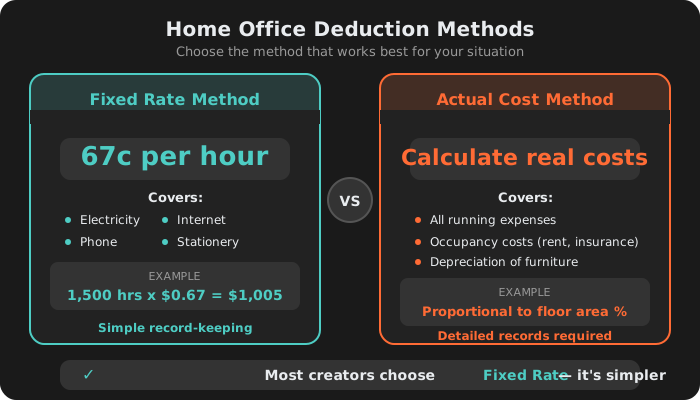
From the 2024-25 financial year onwards, the ATO's fixed rate method allows you to claim 67 cents for every hour you work from home. This rate is designed to cover the costs of electricity, internet, phone, stationery, and computer consumables.
Here is how it works:
- Track your hours. You need to keep a record of every hour you work from home throughout the entire financial year. A spreadsheet, app, or diary is fine.
- Multiply by 67 cents. If you work 1,500 hours from home in a year, your deduction is $1,005. Simple.
- Claim additional items separately. The 67 cents per hour rate does not cover the decline in value of equipment like cameras, computers, or office furniture. You can claim depreciation on these items on top of the fixed rate.
- No need to have a dedicated room. Unlike the actual cost method for occupancy expenses, you do not need a separate room to use the fixed rate method.
For most creators who work from home 20 to 30 hours per week, the fixed rate method can give you a deduction of $700 to $1,050 per year, before you even start adding equipment depreciation on top.
Method 2: The Actual Cost Method
The actual cost method lets you claim the real costs you incur, rather than a flat rate. This method requires more record-keeping but can result in a significantly higher deduction, especially if you have high electricity usage (lighting rigs, gaming PCs, multiple monitors) or expensive internet plans.
Under the actual cost method, you can claim:
Calculate the work-related portion of your electricity bill. If your filming room uses studio lights for 25 hours a week and your gaming PC runs for 30 hours a week, those costs add up. You need to work out the actual cost or a reasonable estimate of the electricity used for work.
Claim the work-related percentage of your internet bill. If you use your connection 70% for uploading videos, streaming, and managing your business, you can claim 70% of the cost. Keep a four-week usage diary as evidence.
The work-related portion of your phone bill is deductible. This includes calls with brand partners, managing social media, and communicating with your audience or team.
Your desk, office chair, shelving, and any other furniture used in your home office can be depreciated over its effective life. Items under $300 can be claimed in full immediately.
If you have a dedicated room used exclusively for work, you may be able to claim a portion of rent, mortgage interest, council rates, and home insurance. This requires a clearly defined area used solely and regularly for business. Be aware this may affect your CGT main residence exemption if you own your home.
Which Method Should You Choose?
The right method depends on your situation. Here is a general guide:
- Choose the fixed rate method if you work moderate hours from home, do not have unusually high running costs, and want to keep your record-keeping simple.
- Choose the actual cost method if you have a dedicated room, high electricity usage from equipment like studio lights or gaming rigs, or an expensive internet plan that is mostly used for work.
- Run the numbers both ways. There is nothing stopping you from calculating your deduction under both methods and choosing whichever gives you the higher claim. Your accountant can help you work this out.
Record-Keeping Requirements
The ATO requires solid records to support your home office deduction claim. Here is what you need to keep:
- A log of hours worked from home for the entire financial year. This is mandatory for the fixed rate method and helpful for the actual cost method.
- Copies of your bills including electricity, internet, and phone if using the actual cost method.
- Receipts for equipment and furniture purchased for your home office.
- A floor plan or photo showing your dedicated workspace, especially if you are claiming occupancy expenses.
- Keep records for five years from the date you lodge your tax return. The ATO can audit you at any time during this period.
Common Mistakes Creators Make
- Not tracking hours. Without a record of hours worked from home, the ATO can disallow your entire home office claim. Start logging your hours now.
- Double-dipping. You cannot claim internet costs under the fixed rate method and then also claim them separately. The fixed rate already includes internet. You can only claim additional items not covered by the rate.
- Claiming 100% of shared expenses. If you share your home with others or use your internet for personal use too, you can only claim the work-related portion.
- Forgetting to claim at all. Many creators do not realise they can claim home office deductions. If you work from home, you are almost certainly entitled to a deduction.
Not Sure Which Method Is Right for You?
We are Chartered Accountants who specialise in creator tax returns. We will calculate your home office deduction both ways and make sure you get the best result.
Get Started