Crypto and NFTs have opened up entirely new revenue streams for content creators. Whether you are getting paid in Bitcoin for a brand deal, selling NFTs of your artwork, or earning fan tokens on a Web3 platform, the ATO wants to know about it. And they have the data-matching tools to find out if you do not report it.
Here is what Australian content creators need to know about crypto and NFT tax.
How the ATO Treats Cryptocurrency
The ATO does not treat cryptocurrency as money. Instead, it classifies crypto as property and a CGT (Capital Gains Tax) asset. This means that every time you dispose of a crypto asset, whether by selling, swapping, gifting, or using it to buy something, a CGT event occurs and you may need to pay tax on any gain.
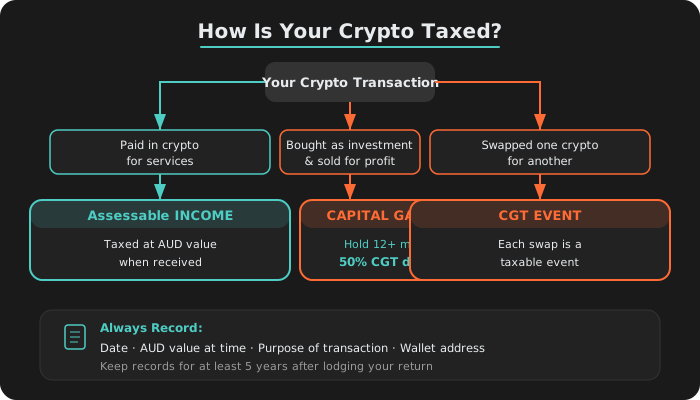
For content creators, the tax treatment depends on how you acquired and used the crypto:
If a brand pays you in crypto instead of cash, or a Web3 platform pays creator earnings in tokens, this is treated as ordinary income. You must convert the crypto to its AUD value at the time you receive it and include it as business income. When you later sell or swap that crypto, a separate CGT event occurs based on any change in value since you received it.
If you buy crypto with your own money and hold it as an investment, any profit when you sell is a capital gain. If you hold for more than 12 months before selling, you get the 50% CGT discount, meaning you only pay tax on half the gain. If you sell at a loss, you can use that capital loss to offset other capital gains.
Trading Bitcoin for Ethereum, or swapping tokens on a decentralised exchange, is a CGT event. You are effectively disposing of one asset and acquiring another. You need to calculate the gain or loss based on the AUD value at the time of the swap.
NFTs: Creator-Specific Tax Scenarios
NFTs add another layer of complexity. The tax treatment depends on whether you are the creator of the NFT or a buyer and seller.
Selling NFTs You Created
If you mint and sell NFTs of your own content, such as digital art, exclusive videos, music, or photography, the ATO generally treats the proceeds as ordinary business income. This is because you are creating and selling a product as part of your content creation business. The full sale amount (minus costs like minting fees and platform commissions) is included in your taxable income at your marginal tax rate.
Earning Royalties on Secondary NFT Sales
Many NFT marketplaces allow creators to earn a royalty each time their NFT is resold. These ongoing royalties are also treated as ordinary income. You need to track and report each royalty payment you receive throughout the financial year.
Fan Tokens and Creator Coins
Some platforms allow creators to issue their own tokens or coins that fans can purchase. If you earn income from the sale of fan tokens, this is generally assessable income. The exact treatment depends on the structure: whether you are selling a service, a digital product, or something else entirely. This is an area where professional advice is strongly recommended.
The 50% CGT Discount
One of the most important tax planning opportunities for crypto-holding creators is the 50% CGT discount. If you are an individual (not a company) and you hold a crypto asset for more than 12 months before selling it, you only pay tax on half of the capital gain.
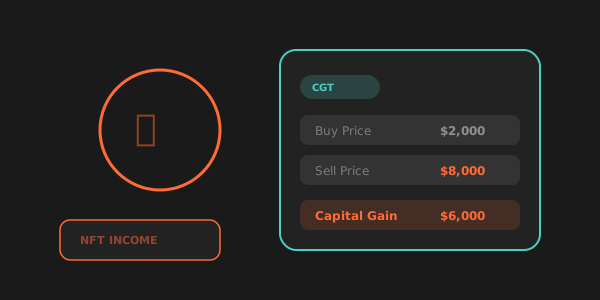
For example, if you bought $5,000 worth of Ethereum and sold it 18 months later for $15,000, your capital gain is $10,000. With the 50% discount, you only include $5,000 in your taxable income.
Important: the CGT discount only applies to crypto held as an investment. It does not apply to crypto received as business income or held as trading stock. If you are actively trading crypto as a business, different rules apply.
Record-Keeping Requirements
The ATO has made it very clear that crypto record-keeping is not optional. They receive data from Australian crypto exchanges and use it for data matching. Here is what you need to keep:
- Date of every transaction. When you bought, sold, swapped, received, or transferred crypto.
- AUD value at the time. For every transaction, record the Australian dollar equivalent. Use a reputable price source.
- The purpose of each transaction. Was it a purchase, sale, swap, payment for services, or gift? The purpose determines the tax treatment.
- Wallet addresses and exchange records. Keep records of which wallets and exchanges you use, and download transaction histories regularly. Exchanges can shut down or lose data.
- Minting and gas fees. These are part of your cost base and can reduce your capital gain or increase your deductible expenses.
- Keep records for five years from the date you lodge your tax return for the relevant year.
Common Mistakes Creators Make with Crypto Tax
- Thinking crypto is anonymous. The ATO receives data from Australian exchanges and has sophisticated data-matching capabilities. They know about your crypto holdings.
- Not reporting crypto received as payment. If a brand paid you in Bitcoin, that is taxable income, just like a cash payment. You cannot avoid tax by accepting crypto instead of dollars.
- Forgetting that swaps are taxable. Every crypto-to-crypto swap is a CGT event. Swapping tokens is not a tax-free exchange.
- Not converting to AUD at the right time. You need the AUD value at the time of each transaction, not when you eventually convert to cash.
- Losing track of cost base. If you cannot prove what you paid for a crypto asset, the ATO may treat your entire sale proceeds as a capital gain with zero cost base.
Need Help with Crypto and NFT Tax?
We offer a dedicated crypto add-on service for creators. We will reconcile your transactions, calculate your gains, and make sure everything is reported correctly. Check our pricing page for details.
Get Started