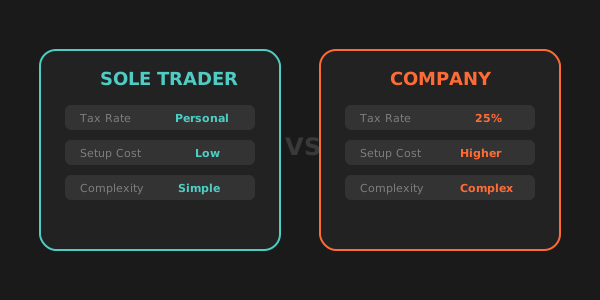
When your creator income starts growing, one of the first big decisions you will face is whether to keep operating as a sole trader or set up a company. It is a question we get from creators almost every week, and the answer is not one-size-fits-all. The right structure depends on how much you earn, how much you reinvest, and where your business is heading.
Here is a practical breakdown to help you decide.
Sole Trader: The Starting Point for Most Creators
Most content creators start as sole traders. It is the simplest and cheapest way to operate a business in Australia. You register an ABN, report your income and expenses on your personal tax return, and that is essentially it.
Advantages of Sole Trader
- Simple and cheap to set up. Getting an ABN is free and takes minutes. There is no company registration fee and no annual ASIC fees.
- Easy tax reporting. Your business income and expenses go on your individual tax return. One return, one lodgement.
- Tax-free threshold. As an individual, the first $18,200 you earn each year is tax-free. If your creator income is your only income, this saves you real money.
- Lower accounting costs. A sole trader tax return is simpler and less expensive to prepare than a company return plus a personal return.
- Full control. You make all the decisions. No director obligations, no corporate governance requirements.
Disadvantages of Sole Trader
- Higher tax rates at higher incomes. As a sole trader, your business profits are taxed at your individual marginal rates. Once your taxable income exceeds $120,000, you are paying 37 cents on each additional dollar. Over $190,000, it is 45 cents.
- No asset protection. As a sole trader, you and your business are the same legal entity. If something goes wrong, like a lawsuit or a debt, your personal assets (car, savings, home) are at risk.
- Harder to bring on partners or investors. If you want to collaborate with another creator or bring in a business partner, a sole trader structure is limiting.
Company: When You Level Up
A company is a separate legal entity. It has its own ABN, its own tax file number, and its own tax return. You become a director and shareholder, and the company earns the income instead of you personally.
Advantages of a Company
- Flat 25% tax rate. A base rate entity company (turnover under $50 million) pays a flat 25% tax on profits. Compare that to the individual rate of 37% on income between $120,001 and $190,000, or 45% above $190,000.
- Asset protection. A company is a separate legal entity. Your personal assets are generally protected from business liabilities. If someone sues the company, they cannot (in most cases) come after your personal savings or home.
- Tax planning flexibility. With a company, you can choose when and how to pay yourself. You can take a salary, pay dividends, or leave profits in the company to reinvest. This gives you more control over your personal tax position.
- Professional credibility. Some brands and business partners prefer to work with a registered company. It signals that you are serious about your business.
Disadvantages of a Company
- Higher costs. Company registration costs around $576 with ASIC. Annual review fees are approximately $310. Accounting and tax preparation costs are significantly higher because you need a company tax return and a personal tax return.
- More compliance. Companies must maintain proper records, lodge annual returns with ASIC, and comply with director obligations under the Corporations Act.
- No tax-free threshold for the company. The company pays 25% on every dollar of profit. You only access the personal tax-free threshold through salary or wages paid to you.
- Complexity of getting money out. You cannot simply withdraw company money for personal use. You must pay yourself through proper channels: salary (with PAYG and super) or dividends. Getting this wrong can create serious tax problems.
Real-World Scenarios for Creators
Let us look at how the numbers play out at different income levels.
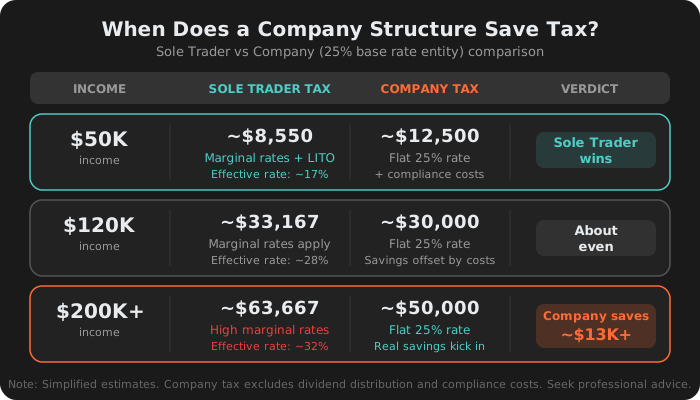
As a sole trader, your tax bill (after the tax-free threshold and Medicare levy) would be approximately $7,717. Through a company paying you a $50,000 salary, the combined tax would be similar once you factor in company tax, PAYG, and super obligations. At this level, the sole trader structure is almost always better because of lower compliance costs. Stick with sole trader.
As a sole trader, your tax bill would be approximately $24,967. With a company, you could pay yourself a salary of $60,000 to $70,000, leave the rest in the company at 25%, and potentially save $2,000 to $4,000 in tax. However, the extra accounting costs ($2,000 to $3,000) may eat into the savings. At $100k, it is borderline. It depends on your growth trajectory and whether you want asset protection.
This is where a company structure really starts to shine. As a sole trader, you would pay approximately $63,667 in tax on $200,000. With a company, you could pay yourself a reasonable salary of $100,000 and leave $100,000 in the company at 25% tax ($25,000). Your personal tax on $100,000 would be around $24,967. Total tax: approximately $49,967 — a saving of roughly $13,700, even after higher accounting costs.
GST Implications
Your business structure does not change your GST obligations. Whether you are a sole trader or a company, you must register for GST when your turnover reaches $75,000. The GST rules work the same way regardless of structure. However, if you switch from sole trader to a company, you will need a new ABN and a new GST registration for the company entity.
When to Make the Switch
There is no magic number, but here are some signals that it might be time to consider a company structure:
- Your taxable income consistently exceeds $120,000 to $150,000. This is where the tax rate difference becomes significant enough to justify the extra costs.
- You want to reinvest profits. If you are buying equipment, hiring editors, or investing in your business, a company lets you do this at a 25% tax rate instead of your personal marginal rate.
- You want asset protection. If your creator business involves risk, whether from contracts, events, merchandise, or public exposure, a company provides a layer of protection for your personal assets.
- You are planning for growth. If you want to hire employees, bring on partners, or eventually sell your business, a company structure is far more flexible.
Not Sure Which Structure Is Right for You?
We help creators choose and set up the right business structure for their situation. Whether you are just starting out or ready to level up, we will run the numbers and give you clear advice. Check out our enterprise solutions for company setup services.
Get Started